
What a Postage Stamp Tells Us About Investing for 30 Years
I want to start with something small.
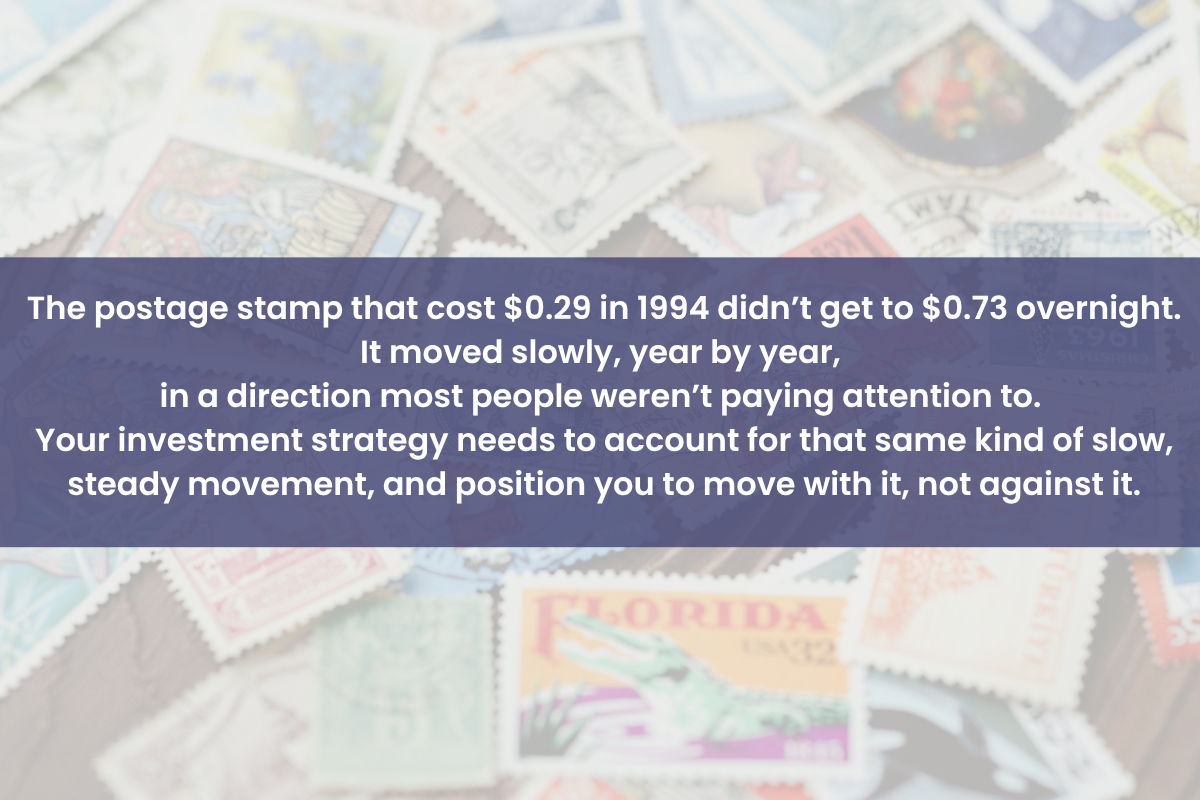
In 1994, a first-class postage stamp cost $0.29. Today, that same stamp costs $0.82. If you had a sheet of 100 stamps in 1994, they would have been worth $29. Today, to replace that same sheet, you’d need $82.
That’s not a complaint about the post office. That’s inflation, quietly doing its thing over 30 years. The 2.5% increase in the price of a postage stamp is almost exactly the Fed’s target inflation rate. This isn’t some dramatic example. It’s just ordinary, boring, expected inflation doing its quiet work…the same quiet force working against your savings every single year.
And it’s one of the clearest illustrations I know of why sitting on the sidelines, keeping your money in cash, waiting for the “right moment” to invest, assuming that doing nothing is safe, is actually one of the riskiest things you can do over time.
Here's what that looks like in real terms: $10,000 in a low-yield savings account in 1994, earning an average of 0.3% annually, grows to about $11,000 today. Sounds fine until you account for inflation. With prices rising around 2.5% per year, you'd need roughly $22,000 today to buy what that $10,000 bought in 1994. Your account grew by $1,000. Your purchasing power quietly lost $11,000.
The Invisible Tax Nobody Talks About
Inflation doesn’t send you a bill. It doesn’t show up as a line item in your budget. It just slowly, steadily erodes what your money can buy.
The stamp example makes this concrete. Most of us have watched prices rise and shrugged it off. A cup of coffee. A gallon of gas. A trip to the grocery store. We adapt. We adjust. We move on. But we don’t always connect that to our savings sitting in a money market account, or worse, an old savings account earning almost nothing, losing a little ground every single year.
Over 30 years, that erosion adds up. And for most of the people I work with, 30 years is exactly the kind of time horizon we’re talking about. Whether you’re in the early stages of building wealth, approaching retirement, or figuring out how to make what you’ve saved last, this is valuable insight.
What a Stamp Can’t Do
Here’s the other thing about a postage stamp: it’s a one-way ticket. You put it on the envelope, you drop it in the box, and you trust the process. There’s no checking in every hour to see if the letter is making progress. No pulling it back out of the mailbox because you heard something unsettling on the news.
Good long-term investing works the same way.
The investors who benefit most from 30-year time horizons aren’t usually the ones making the most trades or following the market most closely. They’re the ones who made a thoughtful plan, committed to it, and then - this is the part that sounds simple but isn’t - stuck with it.
That patience is genuinely hard. Markets move. Headlines scream. Friends share hot tips. And it can feel irresponsible to not react. But pulling out when things dip or chasing returns when things surge, has a measurable cost. Study after study shows that investors consistently earn less than the funds they invest in, simply because they buy high and sell low.
The stamp doesn’t have that problem. It stays the course. And in a long-term investment portfolio, staying the course is most of the job.
The 30-Year Mindset
When someone sits down with me to talk about their financial plan, one of the first questions I ask is: what do you actually want this money to do? Not in the abstract, in the specific. What does your life look like in 10 years? In 30?
Because the answer changes everything about how we invest.
A 30-year horizon gives you something precious: time to recover from downturns, time to let compounding do its work, and time to be patient when being patient feels uncomfortable. It also means that the decisions you make today: whether to invest or wait, whether to diversify or chase a trend, whether to revisit your plan or let anxiety drive your choices – those decisions have consequences that compound just as surely as your returns do.
What This Means for You
If you haven’t looked at your long-term investment strategy recently, or if you’ve been putting off getting one in place because the timing never feels quite right, I’d gently encourage you to reconsider.
The right time to invest for 30 years from now was 30 years ago. The second best time is today.
Not because the market is at a particular level. Not because of what’s happening in Washington or on Wall Street. But because time is the one resource in investing that you genuinely cannot make more of.
If you’d like to talk through what a long-term strategy looks like for your specific situation, I’d love that conversation. You can reach out through the contact page or schedule a time to connect directly.
And next time you put a stamp on an envelope, maybe it’ll remind you of something more than postage.
Jonathan Horst is a CERTIFIED FINANCIAL PLANNER™ and Registered Life Planner® at The Horst Group, a fee-based financial planning firm serving women, LGBTQ+ individuals, and young professionals. To start a conversation about building a financial plan around the life you actually want, schedule a free consultation.